

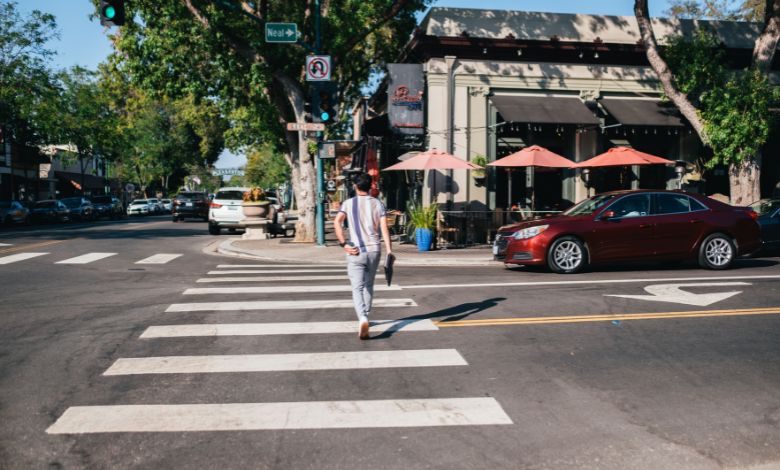
Learn what jaywalking in California really means in 2026, when it’s legal, when you can still get fined, and key safety rules.
I couldn’t believe it the first time someone told me jaywalking I was” legal”. California. My father is still complaining. A$ 190 ticket He met at the crossing a quiet Sacramento street back in’ 90s, So that story stuck with me. Years.
Then last summer, I saw a friend Extract a leisurely stroll down the middle block in an inner street. San Diego, Totally avoided zero cars. Old habits made me flinch anyway.
Turns out, she wasn’t being reckless. She was just current on the Legal Updates surrounding the law. Most people still work off outdated assumptions here, so let’s clear up jaywalking in California for good.
Quick Answer: Is Jaywalking Illegal in CA?
Short version: Jaywalking is technically still going on. The books, But the police cannot furnish you a ticket unless you create your intersection. Immediate danger.
| Situation | Legal Status |
| Crossing mid-block, no traffic nearby | Generally allowed, no ticket |
| Crossing and forcing a driver to brake or swerve | Citable, up to ~$196 + fees |
| Crossing against a “Don’t Walk” signal unsafely | Citable |
| Crossing at a marked crosswalk | Always allowed |
Since the Freedom To Walk Act( Assembly Bill 2147) Affected January 1, 2023, officers generally cannot cease or cite. A pedestrian for jaywalking unless“ reasonable careful person It’s a feeling an immediate danger of a collision.” That single sentence rewrote how California treats mid-block crossing.
Think of it like a house rule your parents stopped enforcing. Technically “no dessert before dinner” was still the rule in my house growing up , nobody actually got grounded over a cookie at 5:30pm. California’s relationship with jaywalking works the same way now. The rule exists; nobody comes after you unless you’re doing something genuinely dangerous.
What the Freedom to Walk Act Actually Changed
I read the actual text of AB 2147 expecting something dense. It’s shorter than you’d think for a law that ended decades of ticketing.
The bill added one key limitation to California Vehicle Code Section 21955: officers can’t stop pedestrians for jaywalking unless there’s an immediate collision risk. That’s the whole mechanism.
Three factors drove the change:
- Enforcement disparities. Data referred to below the bill’s passage Shown jaywalking reference hits Black And low- income pedestrians Asymmetrical Lawmakers not desired a minor infraction used as a pretext For stops unrelated to pedestrian safety.
- Street design. Many California neighborhoods place intersections a quarter-mile apart. Crossing mid-block often becomes the only realistic option.
- Walkability goals. California has pushed toward less car-dependent infrastructure for years. This law fits that broader direction.
None of this means you get a free pass to sprint across six lanes of freeway traffic. You still carry a duty of care for your own safety.
Where the Line Actually Sits
Most people stop reading after “jaywalking is legal now” and miss the nuance. The law draws a specific line.
You’re generally fine when:
- No oncoming traffic sits close enough to pose real risk
- You don’t dart out suddenly or unpredictably
- You don’t cross against a solid “Don’t Walk” signal in a way that endangers anyone
You can still get cited when:
- Your crossing forces a driver to brake suddenly or swerve
- You step out when a car genuinely can’t react in time
- An officer reasonably determines your crossing created immediate collision risk
A citation to unsafe jaywalking Will not waste your life, But it’s nothing. The base fine Walking around$ 196, And court fees and assessments pressure the real total higher. Up: It will not add points. Your driving record. It counts. An infraction, Movement is not a breach. The DMV- point sense.
A Quick Story That Made This Click for Me
I saw a guy step of the curb Central block near a busy six- lane intersection in downtown LA While three cars Almost leaned into it. 35 mph. Drivers slapped their brakes. Horns blared. Chaos lasted about four seconds.
That guy could’ve been ticketed, and honestly, should’ve been. That scenario fits exactly what the law still allows officers to act on.
Compare that to my friend in San Diego, who waited for a completely empty street before crossing calmly. Same technical act , wildly different legal outcome. The danger created determines the outcome, not the act itself. That distinction captures the entire spirit of the Freedom to Walk Act.
What Happens If a Car Hits You While You’re Jaywalking?
This part surprises people most. Even before the law changed, getting hit while jaywalking never automatically killed your case.
California follows “pure comparative negligence.” Fault gets split like a pie, and you can still recover damages even when some of that pie has your name on it.
Example: You’re crossing mid-block. A driver texts and doesn’t see you. A jury might assign you 20% fault and the driver 80% fault. If your damages yesterday$ 50, 000, You will still collect$ 40, 000, not zero.
Drivers Retrieve it now a legal duty To be careful around pedestrians, jaywalking or not. That obligation never changed. If you are injured, document everything: pictures, witness contact info, police report, medical records. Communicate to a personal injury attorney early, Since when comparative- fault arguments Attain complicated swift.
Where Is Jaywalking Illegal? California Is the Exception, Not the Rule
Here’s What surprised me during the survey: California Classification between now the more lenient states I the country But this issue. So if you request where jaywalking is illegal, the honest answer is: almost everywhere, I the traditional sense.
States prefer Texas, Florida, New York, And Arizona Nevertheless, G- walking laws are actively enforced, and fines vary widely from city to city. Some cities Historically enforced. These laws Aggressively enough that jaywalking citations Be a part of a larger national conversation approx racial disparities I traffic enforcement, not only a California issue.
Laws around personal freedom and public safety shift enormously depending on location. Drinking age rules show the same pattern globally. The U. S. Holder a strict age- 21 standard, While some countries Set the bar But 18, And a few places I have historically been allowed to drink. 15 or 16 under certain conditions, to construct the youngest drinking age in the world Shockingly less of American standards. Different cultures attract. Different lines to” acceptable” risk. Jay follows hiking rules. The same logic: Local values and the form of infrastructure the rule more than universal safety math do Bottom line For travelers: Don’t assume. California’s freedom applies elsewhere. Check. Local pedestrian laws Before crossing the outer center block your home state.
Safety Tips for Crossing (Even Though You Legally Can)
A ticket-free crossing doesn’t guarantee a safe one. These habits matter regardless of what the law allows:
- Make eye contact with drivers before stepping out. It signals you as a person, not a blur in their periphery.
- Never assume a driver sees you, even if you see them. Distracted driving happens constantly.
- Wear visible clothing at night. Dark clothes on a dark road create real danger, law or no law.
- Use the crosswalk when it’s convenient. Crosswalks remain the safest option whenever one’s nearby.
- Trust your instincts over your legal rights. Being technically correct means little if a car doesn’t stop in time.
Key Takings
- Is jaywalking illegal in CA? Not really , not the way it used to be. The Freedom to Walk Act moved California from “citation for any mid-block crossing” to “citation only when you genuinely endanger yourself or others.” That approach matches how people already behaved before the law caught up.
- “Mostly legal” doesn’t mean “consequence-free.” Officers still exercise discretion around real danger, fines still apply to unsafe crossings, and both drivers and pedestrians still carry a duty of care toward each other.
- My dad’s old ticket story would play out differently today, but common sense still matters just as much.
- This law expanded pedestrian freedom without erasing pedestrian responsibility. Stay visible, use good judgment, and you’ll cross California streets just fine , crosswalk or not.
Additional Resources
- https://www.dmv.ca.gov/portal/driver-education-and-safety: This official DMV guide outlines pedestrian rights, responsibilities, and best safety practices when walking near or crossing California roadways.
- https://www.chp.ca.gov/programs-services/services-information: The CHP’s pedestrian safety campaign provides practical guidance on crossing streets safely, increasing visibility, and reducing the risk of pedestrian crashes.